
Saturday, June 1 from 10:00 AM – 1:00 PM the Visayan Eskrima Guild will put on a Filipino martial arts workshop in Tracy, CA.
Come discover the highly effective tactical principles embedded within the Philippine martial arts of Cabales Serrada Escrima and Visayan Style Corto Kadena/Larga Mano Eskrima. Grandmast Wade Williams, 2012 U.S. Martial Arts Hall of Fame Instructor of the Year and Maestro George Yore, Author of Sonny Umpad’s Eskrima: The Life and Teachings of A Filipino Martial Arts Master, are pleased to anchor a brotherhood of The Guild event.
Williams Martial Arts Academy
1611 W Durham Ferry Rd
Tracy, CA 95304
$40.00 per person (cash only). On-site registration from 9:15 – 9:55 AM.
For questions, please contact Grandmaster Wade Williams at serrada8@calds1.net. Any policy announcements, additional information, or cancellation notices related to this seminar will be posted on the Seminar Schedule of the Guild’s website: www.thevisayaneskrimaguild.org.
Bruce Lee’s Most Controversial Fight Set For Film Adaption

Yahoo News reported recently that a film based on Bruce Lee’s legendary fight against Chinese kung fu master Wong Jack Man is in the works, tentatively titled “Birth of the Dragon.” This fight, which took place in Oakland, California in 1965, helped Lee obtain his status as a legendary martial artist. There were very few spectators at the original event, and there is still heavy debate about what exactly went on inside the gym:
Groundswell CEO Michael London told Yahoo! Sports on Tuesday that the process of developing a screenplay has just begun.
It is not, however, designed to be a biography of Lee, who died in 1973, or the definitive account of the fight.
“We’re actually not trying to re-tell the story of Bruce Lee,” London said. “I think that’s a natural impression people might get. The idea, actually, is to take that battle, which has been so mysterious and so powerful and so interesting to so many, and tell the lead-up to that story, which is Wong Jack Man’s arrival in San Francisco.”
“We’ve created a back story. There is [sic] a lot people that know about why Wong Jack Man came to San Francisco, but we’re trying to create a dramatically satisfying story about why he’s there. So we’re taking license. That’s why we say it’s going to be inspired by that fight and isn’t a literal telling of it.”
London said the writers — Christopher Wilkinson and Stephen Rivele — have the belief that Jack Man was trying to help Lee to become the best version of himself and was trying to teach Lee lessons…
London said no timetable is set to begin filming. He said “if we’re lucky, we’ll make the movie next year.”
Though the film promises an entertaining spectacle in its fictionalized account of the pivotal fight and its lead-up, it will arguably leave Lee fans hungry for a more historically accurate representation of the events. To many, this fight is especially noteworthy as it allegedly helped cultivate Lee’s views on Jeet Kune Do, a popular form of mixed martial arts practiced today.
Those interes ted in the events of Bruce Lee’s life leading up to this historic fight should check out The Dragon and the Tiger: The Birth of Bruce Lee’s Jeet Kune Do by Greglon Lee and Sid Campbell. Greglon Lee’s father, martial artist James Lee, formed the Jun Fan Gung-fu Institute in conjunction with Bruce Lee in 1962, which is now considered the birthplace of Jeet Kune Do. James Lee’s relationship with Bruce Lee was fundamental in his development into the legend he became. The authors conducted extensive interviews with Bruce Lee’s students and contemporaries, and compiled these with stories pulled from rare documents in order to present a full, captivating picture of his life as a young man. The authors also shed light on Bruce Lee’s life between the years 1962 and 1965, the period directly preceding his fight with Wong Jack Man, which very few had previously chronicled.
If you are more intrigued by Wong Jack Man and his influence, you can explore the work of author Rick Wing, who studied under Man to hone his skills in Northern Shaolin, a form of martial arts originating from Northern China. Blue Snake Books features two titles from Wing: Fu Zhen Song’s Dragon Bagua Zhang, a step-by-step guide for learning this challenging form of martial arts, as well as The Classical Three-Section Staff, an easily understood handbook for mastering the wheeling maneuvers associated with this traditional Chinese weapon.
Can’t get your fill of Bruce Lee? You can also check out Me, Chi, and Bruce Lee, in which author Brian Preston sets out to earn a black belt and answers the question: “why have Eastern martial arts become so popular  worldwide?” Those interested in a comprehensive account of Bruce Lee’s martial arts and movies should pick up Bruce Lee: Fighting Spirit by Bruce Thomas, the only independent biography of the legendary fighter. Starting up where Fighting Spirit leaves off is Thomas’s Bruce Lee: Fighting Words. This book features collections of short essays, interviews, and anecdotes, and uniquely showcases two sides of Bruce Lee: the martial arts superstar, as well as the unfulfilled philosopher.
While chronicling the rise and spread of capoeira from Brazil to the sunny Mission District of San Francisco this week, The SF Bay Guardian did a fantastic job of contextualizing and highlighting women’s increasingly important role in the movement by featuring Márcia Treidler—a.k.a. Mestranda Cigarra—founder of Abadá Capoeira’s SF chapter:
Treidler, who is now one of two of the highest ranking females in her school Abadá’s 41,000-member international organization, started practicing 31 years ago in Rio de Janeiro. She lived in Botafogo, a middle class beachfront neighborhood. At the time, capoeira still wasn’t considered respectable — and certainly not an obvious choice for an ambitious young woman. After becoming entranced by the sport at a school performance, the current Mestranda had to work on her mother for a year before she would agree to finance her classes.
“Women in capoeira was not popular at all,” Treidler says. “[My mother] was like ‘are you crazy? What are you thinking?'” Treidler had been active in sports — swimming and gymnastics — since she was six, but her mother insisted on observing capoeira classes before she’d agree to let her high school age daughter enroll.
“The [sport’s] reputation was really bad at the time,” Treidler remembers. “But when I first started, I never stopped.”
Read the full article here.
Holiday Gift Guide for Ninja Nuts!
Have yourself a stealthy little Christmas, Hanukkah, or Solstice this holiday season with gifts for your favorite ninja enthusiast. From games like Fruit Ninja to translations of ancient ninja scrolls, there’s something for everyone from casual fans to hardcore ninja-philes!
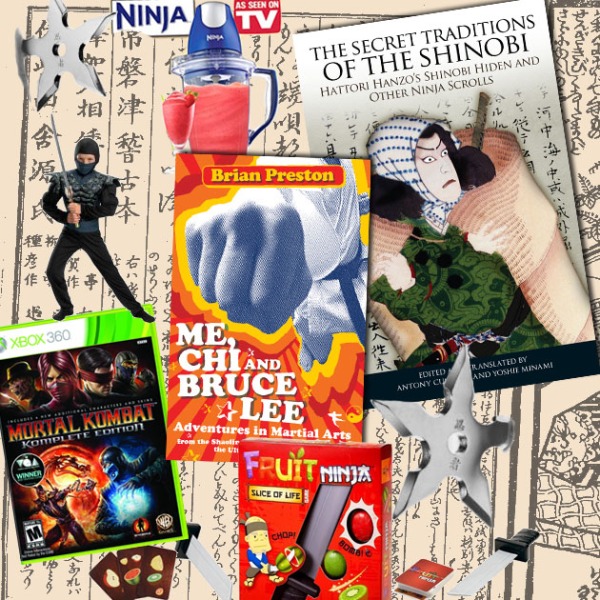
1) The Secret Traditions of the Shinobi: Hattori Hanzo’s Shinobi Hiden and Other Ninja Scrolls by Antony Cummins & Yoshi Minami
Translated into English for the very first time, this widely sought-after collection of historical documents brings to light the secret practices, techniques, philosophies, and lifestyles of the shinobi.
2) Me, Chi, and Bruce Lee: Adventures in Martial Arts by Brian Preston
What happens when a self-styled wuss sets out to earn a black belt? Author Brian Preston’s trek takes him from a kung fu school in his hometown of Victoria, Canada, to the storied Shaolin Temple in China, back to Canada to meet Brazilian Jujitsu legend Royce Gracie, and on to Vegas and the thrills of the Ultimate Fighting Championship.
The Fruit Ninja card game from Mattell is based on the bestselling digital app, Fruit Ninja, offering a battery-free way for your young ones to play. Cut the deck of fruit cards and collect the most fruit to win!
4) Ninja Star Wall-Mounted Coat Hook
he Ninja uses his Katana to do everything from butter his bread to separate his laundry (lights from darks). He uses his hand claws to hold corn and peel potatoes. And, he uses his throwing stars for coat hooks.
The Ninja Professional Blender gives you a professional, hassle-free blender with outstanding performance and a sleek design. Green smoothies ahoy!
6) Mortal Kombat: Komplete Edition
An enhanced re-release of 2011’s high-def Mortal Kombat game for X Box or PS3.
Night Camo Muscle Ninja Kids Costume includes a black and charcoal fabric hood. This Ninja Child Costume is available in child sizes Small (4-6), Medium (7-8) and Large (10-12).
Real Ninja Secrets Recently Uncovered

From Enter the Dragon to Kill Bill, Teenage Mutant Ninja Turtles to Naruto, and Mortal Kombat to Onimusha, the ninja figure has thoroughly cemented itself in 20 and 21st-century pop culture. Countless numbers of children dress up as ninjas for Halloween every year, and it’s not uncommon to run into products like the Ninja blender at the grocery store.
After decades of representation in film, television, video games, product branding and even rap music (I’m looking at you, Wu-Tang), portrayal of the ninja has ranged far and wide. These days, they’re mostly out of the shadows, pursuing vengeance or set on a tournament-style warpath for glory. The historic shinobi agent—defined by his stealth, cunning, and undying allegiance to the kingdom—has been transformed.
Seeking to take contemporary ninja-obsession back to its roots, explorer–historian Antony Cummins has uncovered a wealth of fresh ninja secrets with three never-before-translated ninja scrolls from ancient Japan.
 Published together in his new book, The Secret Traditions of the Shinobi, the scrolls shed new light on the secret practices, techniques, and lifestyles of real ninjas. In the book, fire carrying, throwing torches, floating bridges, sleeping powders, floor tacks, basket elevators, and more are explained in full detail alongside esoteric mantras and other ninjutsu training philosophies. Dating back to the twelfth century—making it the oldest collection of written ninjutsu information in the world—one of the scrolls offers a hundred ninja poems, and another, the Shinobi Hiden, is widely attributed to one of the most famous ninjas of all time, Hattori Hanzo.
In the book, shinobi agents are of the utmost inconspicuousness in terms of appearance and lifestyle. They are never recognized because of their many disguises, embodying the lives of those they impersonate. Some of their best include monkey trainers, sake merchants, craftsman, and medicine peddlers. Because of their unwavering commitment to each unique mission, ninjas never carry anything of distinct value that could trace back to their lords or families. They are instructed that, “Those who go on shinobi missions should sacrifice their lives, attach importance to honor, value honor above life, be loyal to their lord, and throw themselves away for loyalty.”
Their lives are put on the line for whomever they serve, and no evidence is to ever be revealed about their allies and allegiances. Concealment in all aspects is vital, and during night attacks, masks are worn to not only shroud appearances, but to decipher allies from enemy troops. This book tames some of the more fantastical misconceptions of ninjas portrayed in modern culture, and reveals in their stead a vast amount of real-life secrets that add to the mysterious allure of the long-revered shinobi.
(Featured Image: By Sidharta-999 (done by a friend) [Public domain], via Wikimedia Commons)
MMA Should Be Called MMS
What do you think about what Sifu Scott Jensen has to say? Should Mixed Martial Arts be called Mixed Martial Sports?
Renew Your Chi in the Year of the Dragon
“Chi is the life-force energy that keeps each of us alive and connected to one another and to all other living beings. Chi is the life force in the universe, holistically connecting everything together as one whole” – Bruce Frantzis, The Chi Revolution.
Regardless of your age or health condition, you can reclaim your health in the Year of the Dragon by awakening your chi to develop longevity and vitality. The way you sit and stand heavily influences the way your chi flows throughout your body. You might be hunched over your computer right now as you read this, which also blocks your chi from flowing freely.
Start with these six fundamental principles for chi scanning from Bruce Frantzis to improve your posture:
- Your feet are parallel, shoulder’s width apart
- Your weight is evenly balanced on both feet
- No joints are locked; your knees are slightly bent
- Your muscles are relaxed, not clenched, particularly the jaw, stomach, and buttocks muscles
- Your shoulders are relaxed and down
- Your lower back is straight, perpendicular to the ground, with your head neither tilted forward nor backward.
Don’t worry if these steps don’t come to you naturally. Scan your body for tension points and quickly feel the difference.
 Revolution is generally considered something external, explosive. In this book, Bruce Frantzis, renowned chi master and author, challenges readers to embark on an inner revolution to reclaim joy and happiness in life, reverse the effects of aging and release their stress and negative emotions.
Instead of the “no pain, no gain,” mantra of our over-caffeinated, stressed out culture, Frantzis gives readers energetic fitness exercises that comprise the unique Chi Rev Workout™. These transformative exercises teach readers to activate and strengthen their chi and to relax their nervous systems. “The more you relax, the more health, stamina and strength you will have,” says Frantzis.
Blue Snake Books Top 3 Recommended E-Books

Our reading habits are changing drastically, evidenced by the fact that one in six Americans now own e-readers. Reduce some of the stress of the season. If you’re running behind on your holiday shopping list, why not purchase an e-book as a last-minute gift for a friend, family member, or even yourself!
For the week of December 19th, NAB Communities will be recommending the top 3 e-books for each community. Will you be purchasing any e-books as gifts for the holidays?
On the Warrior’s Path: Philosophy, Fighting, and Martial Arts Mythology by Daniele Bolelli
The urge to forge one’s character by fighting, in daily life as well as on the mat, appeals to something deep within us. More than a collection of fighting techniques, martial arts constitute a path to developing body, spirit, and awareness. On the Warrior’s Path connects the martial arts with this larger perspective, merging subtle philosophies with no-holds-barred competition, Nietzsche with Bruce Lee, radical Taoism and Buddhism with the Star Wars Trilogy, traditional martial arts with basketball and American Indian culture. At the center of all these phenomena is the warrior. Though this archetype seems to manifest contradictory values, author Daniele Bolelli describes the heart of this tension: how the training of martial technique leads to a renunciation of violence, and how overcoming fear leads to a unique freedom. Aimed at students at any level or tradition of martial arts but also accessible to the armchair warrior, On the Warrior’s Path brings fresh insights to why martial arts remains an enduring and widespread art and discipline. Two new chapters in this second edition focus on spirituality in the martial arts and the author’s personal journey in the field.
Taijiquan: Through the Western Gate by Rick Barrett
Written specifically for the Western practitioner, Taijiquan: Through the Western Gate blends modern science and philosophy with the traditional wisdoms—drawn from classic t’ai chi literature—that underlie Chinese martial arts. Author Rick Barrett authoritatively describes a wide range of movements, practices, and positions in the context of such topics as being in the zone, effortless power and force versus power, the whole-body energetic connection, instant meditation, and energetic coherence. Step-by-step exercises help make this sometimes daunting discipline simple and accessible.
Kurikara: The Sword and the Serpent by John Maki Evans
Kurikara: The Sword and the Serpent sets out the eight basic principles of swordsmanship common to all Japanese sword schools, emphasizing the cultivation of power and mental focus. Accomplished martial artist John Evans provides practical examples from his experience with the sword arts as well as Mikkyo and shugendo (mountain asceticism). The first foreign student to train with Nakamura Taisaburo sensei—widely acknowledged as the master of the sword art battodo—Evans clearly explains how skill such as Nakamurua sensei’s can be systematically developed through tanren, exercises that meld “inner” and “outer” power. Filled with fascinating anecdotes from Evans’s training in Japan, Kurikara is a useful, inspiring guide to Japanese sword practice and its spiritual underpinnings.
Origins Series: Taekwondo

Have you ever wondered where different disciplines of martial arts came from, what inspired them, and even why certain weapons were created? The goal of our new Origins Series is to uncover the history and origins of some of your favorite martial arts disciplines, methods, and weapons.
The first time I heard the word “Taekwondo” I was 9 years old. I was watching the Nickelodeon cartoon Rocket Power, and the nebbishy character Sam Dullard, affectionately nicknamed “Squid,” was just about to sneak out his bedroom window when he heard a strange noise emanate from the bushes. “Get away — I know Taekwondo!” he yelled, only to discover that it was only his neighbor’s cat. The resurrection of this funny, random, and strangely clear memory of my introduction to Taekwondo prompted me to do two things this morning: A) research what other fictional characters are masters of “the art of the foot and fist,” and B) write a blog post to enlighten others as to the origins of this ultra-popular form of martial arts. For starters, did you know that Batman, Neo from The Matrix, Buffy the Vampire Slayer, and Miss Piggy are all lethal taekwondo masters? I’ll allow Blue Snake author Giles R. Savoie to explain the finer points of the national sport of Korea with this excerpt from his book, Taekwondo: A Technical Manual.

For thousands of years, the Korean martial art of taekwondo has been practiced as a martial art, as a sport, and for selfdefense. Buddhist principles and combat techniques come together in taekwondo, an art that values fighting abilities as well as mental discipline.
In the beginning, approximately four thousand years ago, people practiced taekwondo as a means to defend themselves against animal attacks. To do so, they developed powerful fighting techniques that could be projected in different directions. A painting found on a tombstone erected in 37 BC in the Koguryo kingdom, which covered what is now southern Manchuria and the northern Korean Peninsula, clearly depicts two young men engaged in a taekwondo match.
Wanting to entertain his people, the king of the Paekje kingdom, situated along the Han River on the Korean Peninsula from 18 BC to AD 600, organized taekwondo demonstrations. These activities were enjoyed both by soldiers and other citizens. Taekwondo gained great popularity in the kingdom of Silla, which was in the southeast part of the Korean Peninsula from 57 BC to AD 936. After having conquered the kingdom of Paekje in 668 and Koguryo in 670, Silla unified the three kingdoms, which Silla and its successors maintained for three hundred years. King Jinheung was responsible for unifying the three kingdoms and organizing a military group, the Hwa Rang Do. Military, educational, and social values were taught to the young noblemen who made up the Hwa Rang Do, and they devoted themselves to the development of their minds and bodies to better serve their kingdom. Their martial spirit was a source of inspiration for the whole nation. They followed a code of honor that included loyalty to the nation, respect and obedience to their parents, courage during combat, and wisdom when using force or, when necessary, taking life. This code of honor is present in a different form today : in taekwondo training.
The study of unarmed combat increased in popularity during the Koryo dynasty (935 to 1392). In this period the martial art was called Soo Bak Do, and it was practiced as a sport with detailed rules as well as a form of martial art with a military purpose. The masters of Soo Bak Do used scientific principles to improve the fighting techniques of the art. Soo Bak Do’s popularity allowed the royal family to support and encourage its practice, and often those who distinguished themselves in the art were favored or promoted in both civil and military matters. The Koryo king organized Soo Bak Do events and demonstrations each year. At the end of the Koryo dynasty, Buddhism was no longer the state religion ; King Taejo, founder of the Yi dynasty in 1392, chose Confucianism instead, and consequently the importance of military training, physical conditioning, and the ability to defend the nation was diminished. With the adoption of Confucian ideas, new importance was placed on learning classical Chinese culture, while physical activities were underappreciated. The result was that men of higher social classes now passed the time by reading Chinese classical texts, composing poetry, and practicing music ; physical activities were only practiced by lower-class men. Taekwondo, known in those days by the name Tae Kyon, was losing popularity. Military officers received no recognition at the social or political level. The situation was the exact opposite of what it had been in the previous dynasty.
A change was soon to come with the arrival of King Chongjo, who showed interest in martial arts. In 1790 he ordered General Lee Duck Mu to compile a manual on all martial arts that existed in Korea. This manual rapidly became a classic. Even with his involvement, King Chongjo did not succeed in reversing the disinterest that his people showed for martial arts. But thanks to his manual, the techniques of the martial arts were preserved for future generations. With this disinterest in martial arts and an emphasis instead on military activities, neglect of national defense continued during the eighteenth and nineteenth centuries. There were no organized martial arts schools, and techniques were taught by father to son or by instructors to disciples in secret. The weakness of the military made the country vulnerable. In 1909, Japan invaded Korea and took control. During the occupation, martial arts were forbidden. Having no arms to defend themselves, some Koreans continued to practice Tae Kyon in secret, and in this way Tae Kyon continued to survive and became even stronger. It was an important tool for Koreans to maintain their identity, values, and courage.
Along with the invasion, Koreans came into contact with a Japanese martial art, karate, as well as other Chinese martial arts. Many of their techniques were incorporated into Tae Kyon by Koreans, creating different styles of the art built on the principles of the Tang Soo Do and Kong Soo Do martial arts. After the liberation of Korea in 1945, Koreans were again able to practice their martial arts openly. The Japanese occupation had considerably modified the Korean martial arts, and so many masters were reunited to combine the different styles developed during the occupation ; this was an effort to recover traditional Tae Kyon as it had been prior to the influence of Japanese karate or Chinese styles on Korean culture. After many years of meetings and debates, the directors of the six most influential Korean schools came to an agreement on standardizing the technical teaching methods. Taekwondo was the name chosen to represent this new martial art. In Korean, tae means strikes delivered with the feet, kwon means strikes delivered with the fists, and do means the martial philosophy, the way of life.
As the country was now free, taekwondo could develop at the level of a sport. In October 1962 it was made an official activity at the Forty-third Korean National Games. In 1964 Master Chong Lee came to Canada to teach this martial art. He opened various schools in Quebec that extended into neighboring provinces and nurtured many world champions. Master Gilles R. Savoie became his student and later developed this martial art on the GaspeÅL Peninsula in the eastern part of Quebec. In January 1971 Dr. Un Young Kim was elected president of the Korean Taekwondo Association. He was deeply involved in the development of the discipline and wanted to raise awareness of taekwondo and make it the Korean national sport. In May 1973 he organized the World Taekwondo Federation to structure the evolution of the art to an international level. Under his presidency, the Kukkiwon was built in Seoul. The name means “national sports institute,” and the Kukkiwon became the world taekwondo training headquarters.
In 1975 the World Taekwondo Federation became official at the General Assembly of International Sports Federations. Taekwondo became an official sport at the International Military Sports Council in 1976. And in 1980 taekwondo was elevated to an Olympic sport by the International Olympic Committee. On June 11, 2004, Dr. Chungwon Choue was nominated president of the World Taekwondo Federation. He created a reform committee with the goal of making the sport more exciting and appealing to global audiences by revamping the sport’s world governing body. Taekwondo enjoys wide popularity mainly due to the visibly spectacular feats in sparring, board-breaking demonstrations, and self-defense. We also now know that Buddhist techniques of meditation and concentration elevated taekwondo to a superior level from that of a simple sport.
Taekwondo is an official discipline in the Pan-American Games and in the Olympic Games. Its spiritual side, its relationship with meditation techniques, and its nonviolent Buddhist principles intrigue and attract more and more enthusiasts. In the modern world, where stress takes an increasing toll on us and with self realization hard to attain, traditional taekwondo has the potential to extend its history for the well-being of its enthusiasts.
Origins Series – Ba Gua Zhang
Have you ever wondered where different disciplines of martial arts came from, what inspired them, and even why certain weapons were created? The goal of our new Origins Series is to uncover the history and origins of some of your favorite martial arts disciplines, methods, and weapons.
Internal martial arts, known in Chinese as “Neijia”, are styles of self defense that focus on the mental and spiritual aspects of one’s state. A focus on one’s qi — one’s internal energy — is central to the practice of these forms, which originated as non-violent meditations in Taoist monasteries. One of the most popular of these internal movement practices is Ba Gua Zhang. Literally meaning “eight trigram palm,” it refers to the trigrams of the I Ching, one of the oldest canonical texts in Taoism. Don’t fret if you’re just now realizing how rusty your Chinese vocabulary is. Allen Pittman offers historical background and an entirely new perspective on Ba Gua Zhang for Western novices in Walking the I Ching: The Linear Ba Gua of Gao Yi Sheng by revealing that Ba Gua Zhang need not be performed in circular motions. For a more demonstrable definition of Ba Gua Zhang check out the video above from Jet Li’s 2001 film The One. As a meditative practice not intended to harm opponents, Ba Gua Zhang is a number one choice for Chinese martial art film choreographers!

The earliest combat training, recorded in the Chou dynasty (ca. 1111–256 B.C.) included archery, wrestling, and sword fighting. The Taoist text known as the I Ching (“Book of Changes”) appeared even earlier (ca. 1150 B.C.) and its influence pervaded Chinese culture, penetrating military strategy, philosophy, and physical culture. In the period of the Spring and Autumn Annals (722–482 B.C.), professional warriors appeared among the nobility and another Taoist classic, the Tao Te Ching (literally translated “The Way and Virtue”), surfaced.
During the Warring States period (403–221 B.C.), knight-errantry arose and fighting techniques spread from professional warriors and the nobility to commoners and foot soldiers. Sun Tzu’s The Art of War is traced to this period. The martial (or military) techniques began to branch into methods of civilian self-defense. Much of what remains today is not martial (i.e., is not designed for the battlefield). Coincident with the martial–to–civilian combat transition in China was the development of the yoga systems of India. These may well have influenced early Chinese martial arts. The movement of traditional wisdom along the Silk Road allowed for cross-pollination of combative techniques, methods of concentration, medicine, and philosophical theories. During the Han Dynasty (206 B.C.–A.D. 220), the first references to chivalry appeared in Chinese poetry. Later, chivalry became a significant part of boxing ethics. In the Han Dynasty reference was made to “Six Chapters on Hand Fighting,” which represented the earliest reference to pugilism in China. In the later (or Eastern) Han Dynasty (A.D. 25–220), the physician Hua-T’o taught “Five Animal Exercises,” movements derived from animals to promote health and longevity. These hygienic influences also became a part of Chinese boxing.
According to tradition, a Buddhist missionary called Tamo came from India to Honan Province during the Southern and Northern Dynasties (A.D. 386–589). Though legendary, this event is taken seriously by Chinese scholars. There, at the Shaolin temple, he taught Ch’an (Zen) Buddhism and physical exercises to balance the long hours of sitting meditation. According to tradition, in the Sung Dynasty (A.D. 960–1279) the first emperor, Tai Tzu, created a method of boxing called Chang Ch’uan (Long Boxing). During this same period, Chen Hsi-I of Shansi Province is credited with creating a method called Liu-Ho Ch’uan (Six Harmony Boxing), and General Yueh Fei taught his troops Hsing- I Ch’uan (Form-Intent Boxing). Legend also speaks of a Taoist adept, Chang San-Feng, who lived during the Ming dynasty (A.D. 1368–1644) and taught a new form called Nei Chia (Inner School), which included the system called T’ai Chi Ch’uan (Great Ultimate Boxing). Tradition connects the “Outer School” to Tamo and Buddhism and the “Inner School” to Chang San-Feng and Taoism. The differences between the two pertain primarily to training: Nei means “inner,” which in a boxing context are skills using Chin or “consciously directed” strength; Wai means “outer,” and uses Li, or skills forged from specialized muscular training (like the forged strength of a farmer’s handshake).
The highly coordinated strength of the Nei Chia (“inner family”) methods develops the muscles, tendons, fascia, and organs through movement of the whole body and mind. This holistic strength, or Chin, develops through movements that activate the whole body. It involves the whole person and develops a visceral understanding of body mechanics. Because sports are highly specialized, development of internal qualities is often uncertain.
Wai, or “outside,” implies the outer musculature and physical conditioning associated with weight training. It is quickly developed through movements that isolate the musculature, conditioning it in a specific way. Such training sometimes breaks the unity of the bodymind nexus and shapes it in strict accordance to task. In contrast to this, Ba Gua—a Nei Chia discipline—deliberately involves the integration of all aspects of the human being.
In more recent history, during the Warlord period (1917–1927), bodyguards, some of whom were highly skilled boxers, formed companies. Their notoriety caused an increase of popularity in the practice of Chinese combatives.
Click HERE to check out the last post in the “Origins Series”.
And read more on Ba Gua Zhang HERE!

 Blue Snake Books